• Employee Resources
  • Timesheet
  • Request Employee
  • Find a Job
(978) 689-4455 info@footbridgecompany.com
FootBridge Company
  • Employers
        • Services
          • Direct Hire
          • Contract Hire
          • Payroll
        • Request an Employee
        • Our Expertise
          • Construction Management
          • Engineering
          • Project Controls
          • Project Management
          • Manufacturing
        • Industries
          • Civil & Commercial
          • Data Center
          • Industrial Facilities
          • Manufacturing
          • Oil, Gas & Chemicals
          • Power & Utilities
          • Renewable Energy
  • Job Seekers
    • Job Search
    • Submit Resume
    • Careers at FootBridge
  • About
    • About
    • Management Team
    • Case Studies
    • FAQs
  • Blog
  • Contact
  • Click to open the search input field Click to open the search input field Search
  • Menu Menu
Energy hiring and workforce planning for 2027

Energy Hiring in 2027: A Conversation with Ray LaMonica

Director of the FootBridge Company Energy Division

As we enter the final quarter of 2026, energy hiring and and workforce decisions are shaping projects and outages well into 2027.

With 25+ years of industry experience and thousands of specialized searches conducted each year, FootBridge has a clear view of what companies face as they build the teams those projects will require. The talent is out there, but the conditions for finding, attracting, and securing it have changed. 

Ray LaMonica, Director of the Energy Division at FootBridge, works directly with clients facing these decisions, so we asked him to share what he’s seeing in the market and what energy companies should consider now as they prepare for 2027.

What is making specialized energy talent harder to secure right now?

Ray: It’s not always that the skill set doesn’t exist. The bigger question is how many people with that experience are realistically available for your particular project.

You have to layer in where the project is located, whether the person needs to be on-site, how much travel is involved, and whether that individual is willing to take another project assignment. Once you do that, a talent pool that looked fairly large on paper can become much smaller.

In contract staffing, you’re not just looking for somebody who can do the work. You need someone willing to work under the conditions of that specific assignment.


Where are you seeing that challenge most clearly?

Ray: Schedulers are one of the clearest examples.

Historically, scheduling has been an on-site function. The scheduler is interacting with the project team, walking the job and seeing progress firsthand. Some of that work can technically be performed remotely, but many clients still believe the position is more effective when that person is on-site.

What changed after COVID is candidate expectations. Experienced people became accustomed to working remotely, and today it can be much more difficult to get someone with the right scheduling background to commit to a full-time on-site assignment, especially when travel is involved.

That’s an important distinction for hiring managers. You can have ten people who look qualified on paper, but if only a fraction of them are willing to work at your location under your schedule, that fraction is your real talent pool.

What are companies competing against when they go after those candidates?

Ray: More than the company down the street.

Look at data center development. Those facilities require tremendous amounts of power, which drives additional infrastructure work, improvements, and expansions. That means companies across different projects can end up needing many of the same types of experienced people.

We see the result in our candidate conversations. The people companies want are often considering multiple opportunities, and in some cases multiple offers.

So the hiring manager has to look at the opportunity from the candidate’s perspective. They’re comparing the rate, but they’re also comparing location, travel, schedule, hours, and the project’s duration.

The question isn’t just, “Is this person qualified?” It’s also, “Why would this person choose this project over the other opportunities in front of them?”

How should companies respond when the candidate has multiple opportunities?

Ray: Move faster.

That means removing unnecessary delays from the process. Every day that goes by is another opportunity for that person to get a call about another project. If the candidate already has multiple opportunities, a slow internal process can make the decision for you.

Before you start interviewing, know who needs to meet the candidate, who has authority to approve the rate, and what you’re prepared to offer. When you identify the right person, you should already know what has to happen next.

The time to streamline the hiring process is before the candidate is sitting in front of you.

How does working in this market every day change the way FootBridge recruits?

Ray: We’ve maintained a network of industry-specific people for years, including subject-matter experts who are willing to travel. We stay in contact with them, and many have worked with us before. Doing so gives us information you won’t necessarily get from a résumé or database.

We may know what kinds of projects someone has worked on, whether they’re open to travel, the types of assignments they’ll consider, and whether another opportunity is likely to interest them.

That becomes extremely important when the talent pool is tight. Finding 100 résumés with the right keywords isn’t necessarily valuable if 90 of those people wouldn’t consider the assignment.

The goal is to get to the realistic talent pool as quickly as possible.

Are you seeing companies change how they use contract staffing?

Ray: Yes. We’re seeing companies consider contract staffing, even those that have traditionally focused more heavily on direct hiring.

I think a lot of that comes down to necessity. Companies need to keep their options open and consider different ways of bringing people onto their teams.

Not every workforce need has to be approached the same way. If you have a defined project, an immediate need, or a position at a remote job site, contract staffing may provide another way to access the talent you need.

The important thing is to start with the work that needs to get done and then determine which hiring model makes the most sense.

What would you tell a hiring manager planning projects or outages for 2027?

Ray: Start earlier than you think you need to.

If you know you’re going to need project managers, construction managers, project controls professionals, schedulers, commissioning specialists, engineers, QA/QC or safety professionals in 6 or 12 months, that conversation can start before you have an open requisition.

The earlier we understand the project, the earlier we can start looking at the talent market: Who has the experience? Who is likely to be available? Who will travel? What are people looking for in their next assignment?

Then, if we see a potential issue with location, availability, rate, schedule, or a particularly tight skill set, we can address it before it becomes an urgent hiring problem.

Workforce planning shouldn’t begin when you need someone on-site. It should begin when you know you’ll need them.


What should be on your 2027 workforce planning checklist?

Ray’s perspective points to three questions energy hiring managers should be asking now:

  • Who in the market can actually do the work, and how many of them would realistically consider your assignment?
  • How does your opportunity compare with the other projects competing for those same people?
  • Is your hiring process ready to move forward before the candidate has a reason to go elsewhere?

Those questions are difficult to answer from résumés and job postings alone. They require ongoing visibility into the people doing the work and the projects competing for them.

For more than 25 years, FootBridge has specialized in recruiting for energy and other technical industries. Our Energy team works these searches every day, giving us direct insight into the talent companies need, the assignments candidates will consider, and the factors that can make a difficult search even harder.

If you have a project, outage, or workforce need on the 2027 calendar, now is the time to start the conversation. The earlier FootBridge understands what’s ahead, the more time our team has to assess the market, identify potential constraints, and begin building the talent pipeline your project will require. Have an upcoming project, outage, or workforce need? Talk to the FootBridge Energy team now. 


https://footbridgecompany.com/wp-content/uploads/2026/10/A-Conversation-with-Ray-Lamonica-Director-of-the-FootBridge-Company-Energy-Division.png 580 771 cchatellier@footbridgecompany.com https://footbridgecompany.com/wp-content/uploads/2025/10/footbridge-anniversary-logo.png cchatellier@footbridgecompany.com2026-10-08 08:49:122026-10-08 08:55:21Energy Hiring in 2027: A Conversation with Ray LaMonica

The Energy Hiring Playbook Has Changed. Is Your 2027 Workforce Plan Ready?

A Conversation with Ray Lamonica, Director of the FootBridge Company Energy Division

As we enter the final quarter of 2026, energy companies are making workforce decisions that will shape projects and outages well into 2027. For many, the 2027 workforce plan is already taking shape. With 25+ years of industry experience and thousands of specialized searches conducted each year, FootBridge has a clear view of what companies face as they build the teams those projects will require. The talent is out there, but the conditions for finding, attracting, and securing it have changed. 

Ray LaMonica, Director of the Energy Division at FootBridge, works directly with clients facing these decisions, so we asked him to share what he’s seeing in the market and what energy companies should consider now as they prepare for 2027.

1. The job requirements can shrink your talent pool

Having the right skill set doesn’t necessarily make someone available for the job. For energy projects, requirements around travel and on-site work can quickly narrow the pool of candidates willing to consider an assignment.

Ray points to schedulers as a good example. These roles have traditionally been performed on-site, where schedulers can interact with the project team, walk the job and see progress firsthand. While some scheduling work can be done remotely, many clients still want these professionals on-site.

The challenge is finding experienced schedulers willing to make that commitment. Since the shift toward remote work during the pandemic, Ray has seen more candidates become reluctant to take full-time on-site assignments, particularly when significant travel is involved.

Ray’s advice: Define the non-negotiables early. If a position must be on-site, requires frequent travel, or has other conditions that could limit candidate interest, make those expectations part of the recruiting strategy from the start. Doing so helps recruiters focus on candidates who can do the job and are willing to accept the conditions that come with it.

2. You’re competing for talent across projects, not just companies

Energy companies aren’t recruiting in isolation. The same experienced professionals may be needed across multiple projects, facilities, and even adjacent industries simultaneously. Ray points to data center development as one example. Infrastructure improvements and expansion projects can increase demand for many of the same technical skill sets. And, “A lot of companies are looking for the same people,” Ray says.

FootBridge sees that competition directly in candidate conversations. According to Ray, experienced professionals frequently have multiple opportunities in front of them, and sometimes multiple offers. Pay is part of the decision-making process, but so are travel requirements, work schedules, hours, location, project length, and the overall structure of the assignment. A company may find the right person technically but still lose that candidate because another project offers a better fit for them.

Ray’s advice: Before going to market, understand what you can and cannot change. If the location and schedule are fixed, determine whether there is flexibility elsewhere. If the rate is firm, other aspects of the assignment may carry more weight. The goal is to understand how your opportunity will compete for the people you actually need.

3. Every extra day creates another opportunity to lose the candidate

When asked what companies could do differently during the hiring process, Ray’s answer was immediate:

“Move faster. Every day that goes by, there’s another chance that another project pops up and the individual gets called elsewhere.”

Ray’s advice:

Before interviewing, know:

  • Who needs to meet the candidate?
  • Who can approve the rate?
  • How quickly can feedback be provided?
  • What are you prepared to offer?

Speed starts before the interview. Once those decisions have been made internally, the hiring team is better positioned to act when the right person is identified.

4. The right candidate may not be the exact candidate described on paper

When the available talent pool is already limited, an overly rigid list of requirements can make a difficult search even harder. Therefore, Ray says that hiring teams should distinguish between experience that is truly essential and experience that can transfer from another project, facility, or related environment.

He emphasizes that job titles alone don’t always tell that story. A candidate may not use the exact terminology from the job description in their résumé, even if they have worked in environments that require many of the same skills. For example, instead of asking only whether someone held an exact title, consider the work they performed, the type of facility or project they supported, the systems they worked with, and the responsibilities they held.

Ray’s advice: 

Identify your must-haves early on.  Doing so gives recruiters more room to identify candidates whose experience translates to the work without compromising the qualifications the project truly requires.

5. The hiring model should fit the work

Ray is also seeing companies consider contract staffing even when they have traditionally focused on direct hiring.

“I believe they are doing it out of necessity,” he says. “They need to keep their options open and consider all avenues of hiring.”

Contract staffing may make sense for an urgent need, a project with a defined timeline, an outage, or an assignment at a remote jobsite. A direct-hire approach may make more sense when the need is permanent, and the position is intended to remain part of the organization beyond a particular project. An 18-month project assignment and a long-term permanent position don’t necessarily call for the same recruiting strategy.

Ray’s advice: 

Start with the work, then determine the hiring model. Keeping both contract and direct-hire options available gives hiring teams another lever to use when the project, timeline, or available talent makes one approach more practical than the other.

6. A specialized talent pool changes the search

The first five considerations all lead to a larger question: How do you find people who meet the technical requirements and the realities of the assignment?

A résumé can tell you whether someone has experience in scheduling, commissioning, project controls, engineering, or construction. It usually won’t tell you whether that person is willing to travel to a jobsite, take an on-site assignment, work the required schedule, accept the project duration, or consider another contract right now.

That’s where specialization matters.

FootBridge recruiters have spent years working with professionals across energy and other technical industries. Those relationships often continue from one project to the next, giving our recruiters knowledge that goes beyond what appears in a candidate database.

Ray describes it this way: “We maintain a network of people specific to the industry and subject matter experts who are willing to travel.”

Over time, recruiters learn the environments people have worked in, the assignments they’ve taken, whether they’re open to travel, and the kinds of opportunities they may consider next. 

Ray’s advice: 

Instead of identifying everyone who could technically perform the job and then determining whether the assignment works for them, working with a specialized recruiter can focus more quickly on professionals whose experience, availability, and preferences align with the project.

And because those relationships have been built over time, FootBridge isn’t introducing itself to the talent market every time a new need comes in. We’re going back to a network we know—and that knows us.

7. Don’t wait until the need is urgent to start recruiting

The more specific the requirements, the more valuable time becomes. For clients looking at workforce needs over the next six to 12 months, Ray’s advice is straightforward:

Start planning now.

“Plan ahead for roles by identifying upcoming project and outage needs early, so we have time to find the right talent before the need becomes urgent,” he says.

Earlier conversations give recruiters time to

  • Assess talent
  • Identify requirements that could complicate the search
  • Understand candidate wants
  • Establish realistic expectations before a project deadline starts driving decisions.

Put your 2027 workforce plan to the test

As you map out upcoming projects, outages, and workforce needs, three questions can help identify where recruiting challenges may emerge:

  • How many qualified professionals are realistically suited to the assignment’s conditions?
  • Will those people be available when you need them?
  • Will your opportunity compete with the alternatives they’re likely to have?

Those questions are difficult to answer based on résumés alone.

For more than 25 years, FootBridge has specialized in recruiting for energy and other technical industries. Combined with the thousands of specialized searches we conduct each year, that experience gives our team visibility into both sides of the hiring equation: what companies need and what experienced professionals seek in their next assignment.

The earlier we understand what’s ahead, the more time we have to identify potential constraints, reach the right talent, and help you build a recruiting strategy around the realities of the market.

Have an upcoming project, outage, or workforce need? Talk to the FootBridge Energy team early. The sooner we understand what’s ahead, the more time we have to identify the people you’ll need to make it happen.


https://footbridgecompany.com/wp-content/uploads/2026/10/The-Energy-Hiring-Playbook-Has-Changed.-Is-Your-2027-Workforce-Plan-Ready-.png 580 771 cchatellier@footbridgecompany.com https://footbridgecompany.com/wp-content/uploads/2025/10/footbridge-anniversary-logo.png cchatellier@footbridgecompany.com2026-10-08 08:31:402026-10-08 08:55:13The Energy Hiring Playbook Has Changed. Is Your 2027 Workforce Plan Ready?
The Shrinking Energy Talent Pool: How Late Hiring Derails Projects and What Companies Need to Do Differently Now

The Shrinking Energy Talent Pool: How Late Hiring Derails Projects and What Companies Need to Do Differently Now

I’ve been in energy staffing long enough to see a pattern: When the market heats up, companies start scrambling to find people they should’ve locked in months earlier.

We’re in that moment right now.

On the one hand, capital investment in oil, gas, renewables, and storage is booming. Global clean energy investment reached $2 trillion in 2024, while traditional energy continued to expand through midstream builds, refinery upgrades, and large-scale infrastructure projects. However, at the same time, the skilled labor pool is shrinking rapidly.

According to the Department of Energy, nearly 25% of the U.S. energy workforce is expected to retire or transition out of the workforce by 2030. And that stat isn’t abstract. I see it every day when clients come to us looking for proven commissioning leads, schedulers, or construction managers—and realize the bench isn’t what it used to be.

And here’s the problem: That gap between planning and execution has always existed, but right now, it’s more dangerous than ever. Why? Because we’re experiencing a convergence: legacy talent is retiring just as demand surges. It’s not a short-term hiring challenge, but a long-term structural shift in which I’ve watched companies spend months developing scopes and budgets, only to realize too late that the people they assumed would be available are already booked, or worse, have left.

The Red Flags Are Quiet—Until They’re Not

Misalignments like this show up subtly at first, usually not as a crisis, but as an urgent call for attention.

“Has this person done solar + storage commissioning in Texas before?”
“Can they run a 7FA hot gas path outage without supervision?”
“Are they comfortable managing a remote team without an EPC on-site?”

These aren’t onboarding questions. They’re SOS signals.

What these staffing questions really reflect is this: The project is moving forward, but the people needed to lead it weren’t locked in early enough. At that point, risk has already crept in, including missed milestones, safety exposures, disjointed field teams, or a chain reaction of contractor delays.

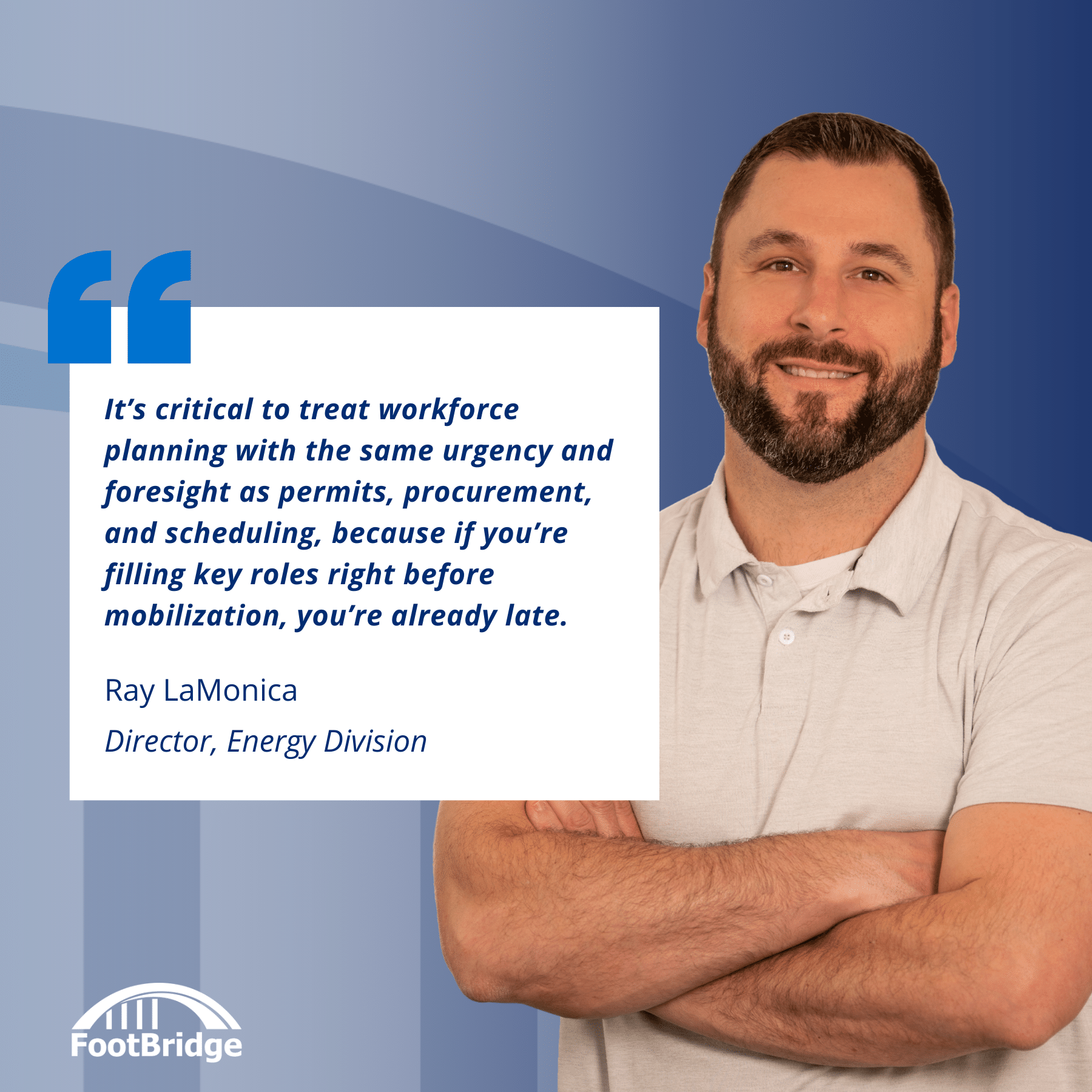
Therefore, it’s critical to treat workforce planning with the same urgency and foresight as permits, procurement, and scheduling, because if you’re filling key roles right before mobilization, you’re already late. Which brings us to the next challenge, and it’s not just about finding people. It’s about finding people who are actually ready to execute.

Yes, resumes are out there. But there’s a significant difference between someone familiar with a technology and someone who’s delivered with it, under pressure. An engineer who’s read the LM6000 manual isn’t the same as one who’s run a startup on one. A scheduler who’s “used P6” isn’t the same as one who’s managed a multi-phase EPC project with it.

What I’m seeing now is that too many hires look good on paper but fall short in the field. When things go wrong, it’s rarely a technical failure; it’s a readiness failure. And in high-risk, regulated environments, there’s no room for that.

Start Sooner. Much Sooner.

So, when is the right time to start hiring for critical roles? Way before you think you need to.

If you’re targeting execution in early 2026, you should be building your team now. The reality is, high-performing professionals are already being scoped, interviewed, and secured by companies with longer timelines and better foresight.

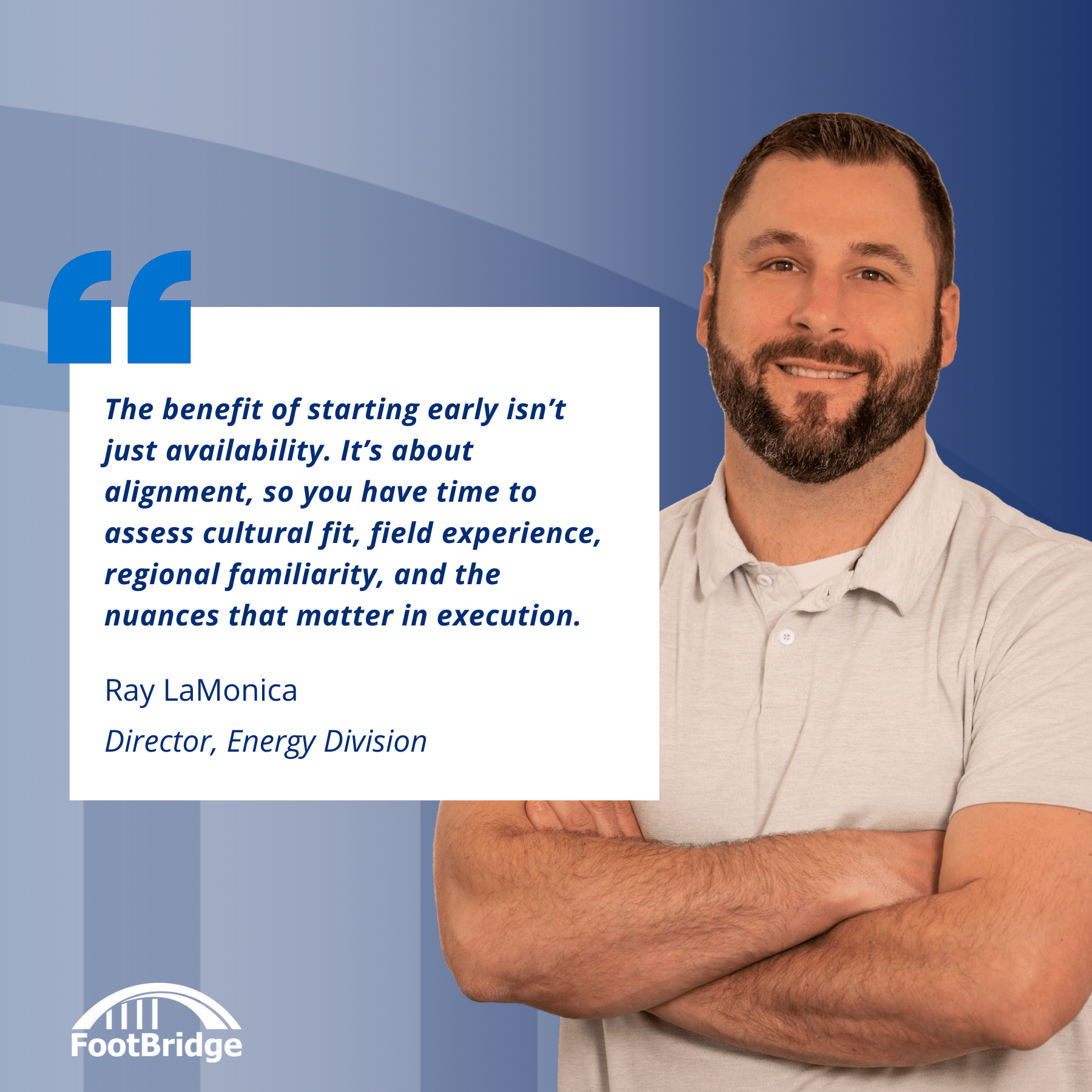
The benefit of starting early isn’t just availability. It’s about alignment, so you have time to assess cultural fit, field experience, regional familiarity, and the nuances that matter in execution. As a staffing firm, we’re not pulling resumes off a pile. We’re building teams that fit the job, the location, and the leadership structure.

And speaking of leadership structure, here’s a shift that’s gaining speed: clients are no longer outsourcing everything to EPCs. They want internal oversight, such as construction managers, QA/QC inspectors, schedulers, and owner’s representatives, that are embedded within the project team, not outside it. 

I’m seeing this across storage, transmission, and utility-scale renewables. Companies want boots on the ground who are accountable directly to them. People who can keep contractors honest, protect their interests, and communicate upstream when things shift in the field. Therefore, you’re no longer just staffing for hands-on execution; you’re staffing for visibility, control, and long-term continuity.

Logistics Will Break You If You Ignore Them.

However, even with the right people in place and internal oversight, you can still encounter significant issues if you overlook a very real factor: location.

Geography remains one of the most underestimated variables in hiring. I’ve seen deals fall apart because travel expectations weren’t clearly communicated, housing wasn’t arranged, or a candidate’s availability didn’t align with the remote site requirements.

A great resume doesn’t mean much if the person behind it can’t or won’t go where the project is. This is especially true for rural battery storage, substation, and transmission jobs. You need to screen for location readiness and logistical compatibility from the start.

Let me give you a recent example. We helped staff a multi-site utility-scale BESS project where the client came to us early. They didn’t wait for problems to arise. They told us exactly what they needed: a construction and commissioning lead who could run independently, coordinate with an EPC, and lead execution across remote locations.

Since they engaged early, we had the time and clarity to identify someone who’d done the same scope, under the same conditions, and under the same pressure. That individual stepped in, synced with the team, and helped maintain project momentum through key phases. That’s not magic. That’s what happens when staffing is treated as a strategy, not a scramble.

Final Word: Don’t Let the Talent Gap Be the Blind Spot

This isn’t a temporary market trend. It’s the new reality. The workforce that built and maintained energy infrastructure for the last 30 years is retiring. The next wave is being pulled across multiple industries, and it won’t be waiting around when your project’s ready to launch.

What I tell clients is simple: If your execution depends on experienced talent, treat hiring like a strategic deliverable. Build it into the scope of development. Plan for it like you plan for long-lead equipment. And talk to your hiring team (or your staffing partner) early—before timelines tighten and options shrink. In today’s energy market, the most significant project risk may not be obtaining permits or securing procurement, but rather assuming the right people will still be available when you finally need them.

Do you need a second opinion on your hiring plan? I’m happy to share what we’re seeing across energy projects nationwide—what’s working, where teams are struggling, and how to get ahead before the real labor crunch hits. Contact me at: rlamonica@footbridgecompany.com.

https://footbridgecompany.com/wp-content/uploads/2025/08/The-Shrinking-Energy-Talent-Pool-How-Late-Hiring-Derails-Projects-and-What-Companies-Need-to-Do-Differently-Now.png 580 771 cchatellier@footbridgecompany.com https://footbridgecompany.com/wp-content/uploads/2025/10/footbridge-anniversary-logo.png cchatellier@footbridgecompany.com2025-08-19 10:13:122025-08-19 10:13:15The Shrinking Energy Talent Pool: How Late Hiring Derails Projects and What Companies Need to Do Differently Now
FootBridge Launches Energy Leadership Series with Host Luke Somers

FootBridge Launches Energy Leadership Series with Host Luke Somers

FootBridge, a leading strategic staffing provider for the energy, utility, construction, and industrial sectors, is proud to announce the launch of the FootBridge Energy Leadership Series, a new monthly video series hosted by Luke Somers, Client Business Manager. 

This series brings candid, experience-driven conversations to the forefront, offering leaders a rare opportunity to hear how top executives navigate high-stakes decisions, manage evolving teams, and lead through rapid industry change. Kicking off with guest Lara M. Nee, CEO of VPO, the first episode is now live on YouTube: Watch Here. 

“After 25 years in the staffing industry, we’ve learned that leadership often happens in the gray areas. When the plan shifts, the stakes rise, and people need clarity,” said Somers. “This series is for professionals leading through exactly those moments.”

Each episode will feature leaders who share real-world insights into how they manage performance, morale, and operations under pressure. Upcoming guests include Ben Seligson (Kraken Engineering), Matt Carrera (CEO, Doble), and Artem Kuchukov (CEO, Kewazo).

https://footbridgecompany.com/wp-content/uploads/2025/08/Meet-Briana-Lowe-Senior-Administrative-Assistant.png 580 771 cchatellier@footbridgecompany.com https://footbridgecompany.com/wp-content/uploads/2025/10/footbridge-anniversary-logo.png cchatellier@footbridgecompany.com2025-08-06 14:04:472025-08-13 15:03:41FootBridge Launches Energy Leadership Series with Host Luke Somers

Is Your Company Looking to Recruit in the Energy Industry?

It will be interesting to see how 2022 shapes up when it comes to the energy hiring process. Looking back at 2021, we saw more jobs than available candidates, making for a very competitive energy hiring landscape. Part of this was due to industry contractors thinking twice about taking the next job. Rather than risk exposure to COVID-19 variants, they’d rather stay closer to home with family and friends. Leaving many companies wondering how to fill the knowledge void as technology advances and experienced employees head towards retirement. 

Like many industries, energy companies face an increased staffing demand compared to available candidates. Therefore, making sure your energy company is maximizing its outreach when it comes to hiring is sure to be a top priority. Here are some key considerations to keep in mind.  

#1 Avoid a Lengthy Hiring Process

Chances are, top prospects in the energy industry are juggling multiple offers or holding out for just the right one. For this reason, companies should swiftly put systems in place to move through the process efficiently. Update your job descriptions to ensure accuracy for the open position and use precise language to entice people to apply. If multiple decision-makers are involved, check to see they will be available throughout the process. There is nothing more frustrating to a candidate than having to wait until a stakeholder gets home from vacation or a conference to find out where they stand, especially when they can go somewhere else. 

Keep in mind that when a candidate submits a resume to the time it takes to review, interview, and assess, you could be looking at weeks before you make an offer.

A recent study from LinkedIn notes it takes anywhere from 33 to 49 days to make a hire, with engineering taking the longest. Make a hiring decision promptly, so the candidate doesn’t move on to other opportunities.

#2 Communicate with a Recruiter

Your recruiter is your lifeline to the energy staffing talent pool, so it’s essential to stay in touch. If you don’t already work with an energy staffing company, now may be the time to consider one. Let them know if the candidates they send are not entirely up to par and why you need to tweak the job description to make a more accurate match or how you are doing in the decision-making process. The advantage of working with a recruiter is they can handle the legwork and remove some of the stress from the hiring process (and reduce the time to hire). 

As soon as you need to hire a candidate for a project, a recruiter can start sourcing them. In many cases, they can have someone on sight the next day. Contrarily, waiting to hire a permanent energy employee could put your company at risk of losing a contract. Not to mention you still have to pay the benefits and insurances on behalf of the employee. 

The benefits of a staffing partnership can not only help you save on long-term hiring costs, but you are also more likely to get the right candidate fit for the position in which you are hiring.

#3 Seek Passive Candidates

According to LinkedIn, 70 percent of the global workforce comprises passive talent. Passive talent is being considered for a position without actively searching for one. However, recruiters spend years building up a network of contacts – passive ones included and know many candidates can be placed more than once throughout their careers. Often, today’s job seeker is tomorrow’s hiring manager. Additionally, most candidates say being contacted by their prospective manager can make them accept a job faster. 

Want more energy hiring tips? At the FootBridge Company, our experienced recruiters specialize in acquiring top energy talent. Trust us to guide the process. We will help you remain ahead of the competition and avoid hiring mistakes every step of the way. Contact us today to learn more about our energy staffing solutions.

https://footbridgecompany.com/wp-content/uploads/2023/08/Is-Your-Company-Looking-to-Recruit-in-the-Energy-Industry-FootBridge-Staffing-scaled-1.jpg 1319 2560 competenow https://footbridgecompany.com/wp-content/uploads/2025/10/footbridge-anniversary-logo.png competenow2022-01-19 09:19:512022-01-19 09:19:51Is Your Company Looking to Recruit in the Energy Industry?

Energy Jobs – A Look at the Market and the Demand for Natural Gas

Here in New England, we just had our first snowfall, and it’s exciting to think of all the winter activities we can take advantage of soon.  However, with the white stuff also comes concerns about the rising cost of natural gas and whether there will be enough to go around. Recent headlines indicate natural gas supply chain shortages could be a reality this winter, with rolling blackouts reminiscent of the 2021 Texas outages. 

Natural gas powers electrical plants, and the colder it gets, the more we reach for the thermostat. Unfortunately, scheduled outages can happen, so the entire grid doesn’t go down. Leaving some wondering why the slowdown in natural gas supply in the first place? According to the Brookings Institute, disruptions in natural gas supplies are due to several factors, including:

  • A rebound in energy use following the COVID-19 pandemic
  • Increased usage despite a continued shortage in natural gas supplies
  • Heightened demand equals higher prices
  • Global competition for gas supply
  • A decline in coal power generation and more reliance on natural gas

All of which also leads to higher costs in the energy market to the extend some analysts predict rising natural gas prices will continue into 2025 as prices in Europe rise and some U.K. suppliers have been forced to close due to a lack of workers. In some instances, the shortage of natural gas has even led to the re-powering of coal plants (Coal is a non-renewable fossil fuel that, when burned, emits sulfur dioxide, nitrogen oxides, and carbon dioxide, which is a contributor to global warming). 

While coal isn’t a clean energy market source, the industry has found ways to reduce harmful emissions, including flue gas desulfurization equipment, also known as scrubbers, to clean sulfur from the smoke before leaving their smokestacks. The coal industry and the U.S. government are also developing technology to make coal more energy efficient. Meanwhile, the U.S. is the world’s largest natural gas producer, with Texas, Oklahoma, New Mexico, Wyoming, and Louisiana topping production. We also have the most miles of pipelines (1.2 million).  In addition to being used for home heating, natural gas is also a raw material for paints, fertilizers, plastics, antifreeze, and medicine, contributing to shortages. 

What does all this mean for energy jobs? 

In a previous blog post, we discussed how the North American natural gas infrastructure is a highly integrated distribution grid of producing wells, gathering lines, processors, transmission and distribution pipelines, compressor stations, and storage facilities. It can transport natural gas to and from nearly any lower 48 States with over 90% efficiency. All of which requires workers. 

Post COVID-19, however, it’s thought that more baby boomers are opting for early retirement, a trend we’re seeing with contractors. Just as there is a demand for natural gas though, there also exists a need for workers. The American Petroleum Institute (API) predicts 1.9 million job opportunities through 2035, providing ample opportunity for millennials (those born between the 1980s and 2000). 

Additionally, the average earnings for oil and gas workers can’t be beaten. According to the U.S. Bureau of Labor Statistics, the average wage for petroleum engineers in 2020 was $137 330. Here are some more top-paying oil and gas jobs and their earnings:

  • Chemical Engineer – $68K to 108K/year
  • Drilling Operator – $29/hour
  • Oil And Natural Gas Landman – $100k/year
  • Oil Rig Roughneck – $42k/year
  • Geologist – $93k/year


In summary, the natural gas grid plays a crucial role in our energy independence and is where the future of energy lies in the United States. The industry is preparing by investing in inclusive, diverse, and resilient workforces. In particular, energy staffing firms like FootBridge can assist in the search for qualified workers. 

For more information on pursuing a career in the energy industry, please contact FootBridge Energy Services today.

https://footbridgecompany.com/wp-content/uploads/2023/08/Energy-Jobs-A-Look-at-the-Market-and-the-Demand-for-Natural-Gas-FootBridge-Staffing.jpg 1371 1920 competenow https://footbridgecompany.com/wp-content/uploads/2025/10/footbridge-anniversary-logo.png competenow2021-12-22 02:23:052021-12-22 02:23:05Energy Jobs – A Look at the Market and the Demand for Natural Gas

Energy and Artificial Intelligence (AI) – The Wave of the Future?

What do frozen peas and artificial intelligence (AI) have to do with one another? No, it’s not a new Sci-fi movie, but a way for grocery stores to conserve energy during peak demand times with a bit of help from technology.  The idea being AI can predict when the need will be high and lower freezer temps earlier in the day, thereby autonomously returning to normal temps during peak times.

In the same article, the author notes, “AI is poised to transform the entire energy sector in the coming years, by helping overcome energy’s inherently variable and uncertain nature, and by accelerating the adoption of renewables.”

It’s not just grocery stores making the most of AI to conserve energy. Google uses the technology to predict when its data centers get too hot, so that cooling systems are automatically activated, reducing energy costs by 40 percent. Manufacturing companies, oil and gas firms, energy services, transportation, forestry, the environment, and many other industries also use smart technology to drive efficiencies and reduce energy consumption.

Smarter energy storage makes it easier to harness power.

There’s tremendous pressure on utilities to have storm preparedness plans, so they use outage management systems for grid oversight and restoring power during outages. Advancements in AI can only improve these platforms.

According to BCG Analysis, AI for climate control could help reduce five to ten percent of greenhouse gas emissions by 2030. Remember the 2021 Texas winter snowstorm that caused excessive power outages? AI could have predicted the weather, prepared for the outages by activating alternative energy sources, and routed power to locations that needed it most.

It takes a lot of power to run machines.

However, concerns surround AI, including how much computing power is needed to run the complex algorithms, not to mention the “training” and “building” of AI models.  Some studies compare building them to automobile emissions and powering homes. So, while AI has the “power” to accelerate reductions in global carbon emissions, nearly 300,000 kilograms of carbon dioxide equivalent emissions are created during training a single model, which is the equivalent of 125 round-trip flights between New York and Beijing. That’s because a lot goes into AI, including cloud storage, hardware, and server locations. It also takes a lot of attempts to perfect the algorithms, which in turn means energy consumption.

According to the EPA, in 2019, electricity consumption, including fossil fuels and natural gas (25 percent), was second to transportation (29 percent). Work is being done, however, to lower AI’s carbon footprint. MIT researchers, for example, have implemented a new automated AI system for training and running specific neural networks.  According to the article “Reducing the Footprint of Artificial Intelligence,” researchers could reduce AI’s carbon byproducts to the low triple digits.

Is renewable the answer?

Aside from relying on a hundred percent renewable energy, other solutions to lowering AI’s carbon footprint may include reducing the “training” process. The movement, Green AI, aims to make machine learning cleaner, moving training sessions to locations that use renewable or green energy. There’s even a tool to measure the electricity an AI program will use and its equivalent carbon output.

In the end, AI plays a pertinent role in improving power grids and a host of other industries, and there is ongoing research to improve the energy that goes into it.

At FootBridge, our recruiters specialize in finding the energy contract talent our clients need, so you’ll always have experienced professionals ready to step into any project. Contact us today to learn more.

https://footbridgecompany.com/wp-content/uploads/2023/08/Energy-and-Artificial-Intelligence-AI-The-Wave-of-the-Future-FootBridge.png 1020 1544 competenow https://footbridgecompany.com/wp-content/uploads/2025/10/footbridge-anniversary-logo.png competenow2021-10-08 18:59:282021-10-08 18:59:28Energy and Artificial Intelligence (AI) – The Wave of the Future?

A Look at the Biden Administration’s Impact on Energy Jobs

Did you know the new Biden administration is committed to investing in zero-net carbon technologies as the country transitions to 100 percent renewable energy for electricity generation 2035 and overall net-zero emissions by 2050? With 3 million people employed in today’s clean energy market, achieving these goals could mean more than 10 million more energy jobs to support the initiative, something we at FootBridge have our eye on. According to Joe Biden’s website, the transition from fossil fuels to renewable sources would include small modular nuclear reactors, zero net energy buildings, and decarbonization. However, how soon this will happen is yet to be seen, as some challenges are on the horizon.

For instance, the Biden investment in green energy jobs may be stilted by Congress as the president would need total democratic support and possibly even some republicans as well. Additionally, holding up approval could be the new COVID-19 stimulus relief package. Plus, while clean energy initiatives are good for the environment, they also mean lost energy jobs such as those seen with the Keystone XL pipeline and other rural towns that rely on fossil fuels to support their economy.

CNN reported that “For every direct job lost in a power plant or mining, the community loses four indirect jobs,” This, according to Heidi Binko, executive director of the Just Transition Fund, which has been working on projects in coal communities since 2015. The same article points out that as traditional fossil fuel positions make way for the new, greener initiatives, there will be room for former workers to take on jobs, including those needed to repair damage caused by strip mines and oil wells.

Energy Job Reports

Additionally, in January 2021, there was a 60-day moratorium placed on new oil and gas leases on federal land, which according to The American Petroleum Institute (API), if a ban is made permanent, would cost 18,000 jobs in Colorado, 33,000 in Wyoming, and 62,000 in New Mexico by next year. Whether or not a permanent ban would happen is yet to be seen, but oil and gas companies are preparing for changes.

We also saw that the Brookings Institution released a report on how renewable energy jobs can uplift fossil fuel communities that heavily rely on these resources for income. Although considered political, “many fossil fuel hubs are ideal sites for renewable energy production. In total, a quarter of the counties in the U.S. with the greatest potential for both wind and solar electricity are also fossil fuel hubs,” the report states.

It’s a similar perspective as to what we’ve said before about transitioning workers from hard-hit COVID-19 industries such as automotive, restaurant, retail, and hobbyists to manufacturing. So far, we do not see a tremendous impact on traditional energy jobs’ availability – and continue to work with a wide range of energy firms who need talent. For a list of our open positions, check out our job search page. On a side note, energy jobs pay 25 percent more than the national median wage earnings.

For a complete list of energy job openings, search the FootBridge job search page.  We’re always hiring!

https://footbridgecompany.com/wp-content/uploads/2023/08/A-Look-at-the-Biden-Administrations-Impact-on-Energy-Jobs.jpg 640 1280 competenow https://footbridgecompany.com/wp-content/uploads/2025/10/footbridge-anniversary-logo.png competenow2021-03-22 20:16:172021-03-22 20:16:17A Look at the Biden Administration’s Impact on Energy Jobs

We Can Help You Find Work in Energy!

The energy industry is unique in many ways, from its resources to the people and capabilities it needs to achieve its goals. Recent graduates and career professionals seeking work in this industry can benefit from working with a recruiter specializing in making connections within the energy field. A specialized recruiter will focus on connecting you with the right people and job openings. But that’s not all we do. Continue reading to learn more about why an energy staffing firm partnership might be the right choice for you. 

According to a recent Deloitte report, seventy percent of jobs lost due to the COVID-19 pandemic may not return until the end of 2021. But as the authors note, “Disruption and technology have a record of creating jobs, not destroying them…they transform the entire way of working for an organization.” With so many variables to deal with in today’s energy market, the right recruiter can undoubtedly make a difference in your job search. 


Find a recruiting firm that understands the geographic areas that interest you


In addition to focusing on the energy industry, your chosen recruiter should spend considerable time working with companies in the geographic regions that interest you most. For example, if you’re interested in working in the northeast’s nuclear power industry, look for a recruiter who has built strong relationships in this location.


Market your skillset


A focus on automation, robotics, smart technologies and big data means energy companies will need to keep innovating in technological areas. Looking forward to 2021, companies need engineers with technical skills and a creative outlook to learn emerging technologies and develop new ones. Incorporating needed skills into a staffing plan can help hiring managers target the right capabilities, as can coordinating with a recruiting partner with a deep knowledge of the skills that available talent offers.


Ask what your recruiter can do for you


Your recruiting partner’s job board is just a starting point. Talk with recruiters about other needs, such as working on fine-tuning your resume or interview skills, determining what company culture helps you thrive, and further assistance. The best recruiters focus on building relationships, so they’ll be interested to know more about you and willing to help you determine what kind of job best fits your needs.


Help your recruiter help you


When you meet with a potential recruiting firm for an interview, treat it as you would any job interview. Doing so helps your recruiter gauge how you interview, so they can provide specialized tips and connect you with jobs that will offer a better fit. Stay in touch with your recruiter throughout the process. Your recruiter can help answer questions and put you on the right track toward the best job and company for your career goals.

At the Footbridge Company, our recruiters can help you land the oil or gas industry job of your dreams. Contact the energy recruiting partners to learn more.

https://footbridgecompany.com/wp-content/uploads/2023/08/pexels-tim-gouw-70292.jpg 1276 1910 competenow https://footbridgecompany.com/wp-content/uploads/2025/10/footbridge-anniversary-logo.png competenow2020-11-21 15:21:092020-11-21 15:21:09We Can Help You Find Work in Energy!
Page 1 of 212

Search by Keyword

Search Search

Related News

  • Energy Hiring in 2027: A Conversation with Ray LaMonica
  • The Energy Hiring Playbook Has Changed. Is Your 2027 Workforce Plan Ready?
  • The Roles Everyone Needs, But No One Can Find
  • A Trusted Staffing Partner for Every Phase of Data Center Construction Projects
  • What Hiring Managers Need to Know About Today’s Engineering and Energy Workforce – A Conversation with Recruiting Manager Steve Cochrane
linkedin icon facebook icon instagram icon twitter icon

Contact Info

200 Brickstone Square
Suite 405
Andover, MA 01810
Get Directions →

(978) 689-4455

Send Email

Employers

  • Services
  • Our Expertise
  • Industries

Job Seekers

  • Job Search
  • Submit Resume
  • Careers at FootBridge

Links

  • About
  • Management Team
  • Case Studies
  • FAQs
  • Blog
  • Contact

 Copyright © 2026 FootBridge. All rights reserved. Website Design by Compete Now | Privacy Policy | Diversity Statement| Corporate and Social Responsibility Policy

  • Employers
    • Services
      • Direct Hire
      • Contract Hire
      • Payroll
      • Back
    • Our Expertise
      • Construction Management
      • Engineering
      • Project Controls
      • Project Management
      • Manufacturing
      • Back
    • Industries
      • Civil & Commercial
      • Data Center
      • Industrial Facilities
      • Manufacturing
      • Oil, Gas & Chemicals
      • Power & Utilities
      • Renewable Energy
      • Back
    • Back
  • Job Seekers
    • Job Search
    • Submit Resume
    • Careers at FootBridge
    • Back
  • About
    • About
    • Management Team
    • Case Studies
    • FAQs
    • Back
  • Blog
  • Contact

Quick Links

  • Employee Resources
  • Timesheet
  • Request Employee
  • Find a Job

    Contact Us

  • (978) 489-4455
  • info@footbridgecompany.com

International Assignment Capability

Are you looking to fill a need for your project internationally? We would love to hear from you. We have experience with international projects and know how to navigate the various implications of a multinational project.

Since 2000

FootBridge was founded in 2000, boasting several employees with 15+ year tenure.

Average employee tenure of 5.4 years

At FootBridge, our average employee tenure of 5.4 years stands as a testament to our deep commitment to employee satisfaction and growth. This longevity ensures our clients consistently receive service from highly experienced professionals, who bring a wealth of knowledge and a thorough understanding of both their roles and the industry.

Operating in all 50 states

FootBridge is operating in all 50 states, meaning we have the ability to offer a wide-reaching network of opportunities and talent, accommodating clients and candidates across the entire U.S. This nationwide presence enables us to quickly and efficiently meet diverse staffing needs, ensuring compliance with varying state regulations and employment laws, which enhances reliability and service quality for both employers and job seekers.

Privately Held Company

Being a privately held company offers the flexibility to make swift, strategic decisions without worrying about shareholder demands or public market pressures. This autonomy allows for a personalized approach to our staffing relationships, fostering innovation and long-term planning aligned with the company’s core values and vision.